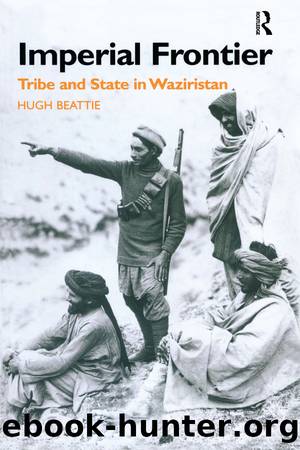
Imperial Frontier by Dr Hugh Beattie Hugh Beattie
Author:Dr Hugh Beattie, Hugh Beattie [Dr Hugh Beattie, Hugh Beattie]
Language: eng
Format: epub
Tags: Social Science, Ethnic Studies, General, Regional Studies
ISBN: 9781136839573
Google: ZEhdAgAAQBAJ
Barnesnoble:
Publisher: Routledge
Published: 2013-12-16T00:58:07+00:00
Collective responsibility
Tribal management also had to be based on some model of how tribal society worked, or could be made to work, because when it came to giving the tribesmen land to settle on or appointments in the militia, or negotiating pass responsibility agreements, decisions had to be made about who should be the beneficiaries of or the parties to the agreements. Writing in the early nineteenth century, Elphinstone, perceiving that the Pashtun tribe, or ooloos (ulus) was not quite like the Highland clan because peopleâs loyalty was to the group rather than as among the Highlanders to the chief, described it as âclannish communityâ.61 His ideas almost certainly had some influence on the Punjab officials, and the way that as we saw in chapter two they mostly envisaged the Pashtun tribes of the frontier as corporate groups, âmoral communitiesâ, all the members of which were in some respects and to some extent at least responsible for each other. So, for example, in the early 1880s Ibbetson explained that the Pathan ânationâ was divided into a few great sections which had no corporate existence. The âtribeâ was âthe practical unitâ, he said, having âa very distinct corporate existenceâ, and being in turn split up into clans and septs, each tribe and clan occupying a clearly defined tract of country. Tribe, clan, and sept were, he continued, distinguished by âpatronymics formed from the name of the common ancestor by the addition of the word Zai, or Khelâ.62
In practice, however, the British officials were never very precise or consistent in their use of terms like tribe, clan, and section, and applied them almost interchangeably, so that on different occasions the Muhammad Khels, for example, were referred to by all three (and their sections were even referred to on one occasion as castes).63 Sometimes as we have seen this gave rise to problems. Taylor fairly consistently used âtribeâ to refer to the Mahsuds as a whole, and âsectionâ for the Alizais, Bahlolzais and Shaman Khels, and the smaller divisions, but his ambiguous use of these terms in 1861 led to a misunderstanding between him and Montgomery.64 Later in the century some officials began to try and evolve a more exact terminology. Trevor Plowden, the Kohat Deputy Commissioner in the 1870s, for instance, in a report written in 1880 (in which he referred to Elphinstoneâs discussion), argued that âpractically, large communities, like the Afridis, Orakzais, and Wazirs, have been regarded as tribes, which are divided into more or less main divisions, as the Adam Khel, Lashkarzai and Ahmedzai; these again being sub-divided into clans, as the Jowaki, Alisherzai, and Kabul Khel. The clans ramify into numerous small âsectionsâ and smaller âsub-sectionsâ, till the ultimate unit, the family, is reached.â65 In practice it was never that simple, but it is true that, whatever terms they used, the British tended to think of tribes, clans and lineages as corporate groups, which persisted over time.66
The perception that the tribe was a corporate group meant, as we have
Download
This site does not store any files on its server. We only index and link to content provided by other sites. Please contact the content providers to delete copyright contents if any and email us, we'll remove relevant links or contents immediately.
Spell It Out by David Crystal(36117)
Life for Me Ain't Been No Crystal Stair by Susan Sheehan(35811)
Cecilia; Or, Memoirs of an Heiress — Volume 1 by Fanny Burney(32558)
The Great Music City by Andrea Baker(32019)
Cecilia; Or, Memoirs of an Heiress — Volume 2 by Fanny Burney(31956)
Cecilia; Or, Memoirs of an Heiress — Volume 3 by Fanny Burney(31942)
Professional Troublemaker by Luvvie Ajayi Jones(29662)
The Secret History by Donna Tartt(19088)
We're Going to Need More Wine by Gabrielle Union(19046)
Twilight of the Idols With the Antichrist and Ecce Homo by Friedrich Nietzsche(18632)
All the Missing Girls by Megan Miranda(16027)
Cat's cradle by Kurt Vonnegut(15355)
Pimp by Iceberg Slim(14507)
For the Love of Europe by Rick Steves(14121)
Bombshells: Glamour Girls of a Lifetime by Sullivan Steve(14075)
Talking to Strangers by Malcolm Gladwell(13370)
Norse Mythology by Gaiman Neil(13365)
Fifty Shades Freed by E L James(13241)
The Social Justice Warrior Handbook by Lisa De Pasquale(12190)
